
Reviewed · BUDAPEST
Analog Photo Trip
Budapest is especially good at sunset, when the Danube, bridges, and grand buildings begin to glow. This analog photo trip turns that familiar city view into an active outing: you learn the camera, take real photographs, and move between major sights by foot and public transport. Guide Emese Tárnok adds short stories about the city along the way.
I like the mix of famous places and less obvious viewpoints, especially the Chain Bridge with Buda Castle behind it and the broad view from Margaret Bridge. I also like the small-group limit of 12 and the chance to take home physical photographs, rather than only another set of phone images.
The main drawback is the price, $142.97 per person, for about three and a half hours. It also depends on good weather, and the short stops mean this is better for a lively introduction than for a slow, detailed photo workshop.
Key points at a glance
- Analog cameras make the sightseeing more hands-on: Emese gives you a brief introduction before you start taking pictures.
- The route links both sides of Budapest: You move from central Pest across the Danube and finish in the Castle District.
- Tram 2 adds a useful city view: The ride helps connect the central stops with the riverfront portion of the outing.
- The route covers major Budapest icons: You see St. Stephen’s Basilica, the Chain Bridge, Parliament, Matthias Church, and Fisherman’s Bastion.
- The group is capped at 12 people: That should make it easier to ask questions and get help with the camera.
- The finish is scenic but not central: The tour ends at Fisherman’s Bastion, so plan your evening from the Buda Castle area.
Why an analog camera changes a Budapest walk
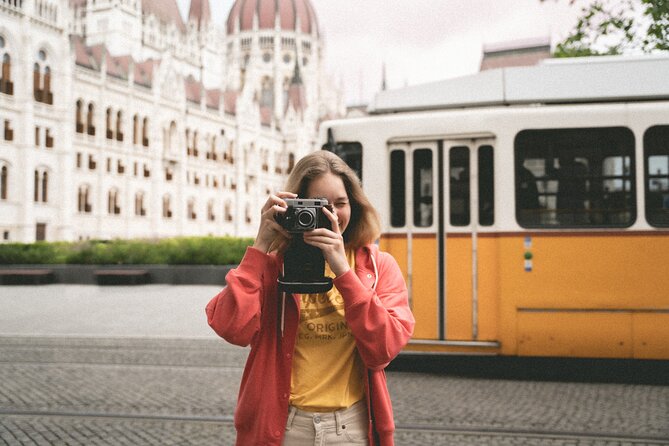
A phone encourages quick snapshots. An analog camera asks you to pause. You have to frame the building, judge the view, and decide when a picture is worth taking. That slower pace is the central idea here, and it gives the sightseeing a clear purpose.
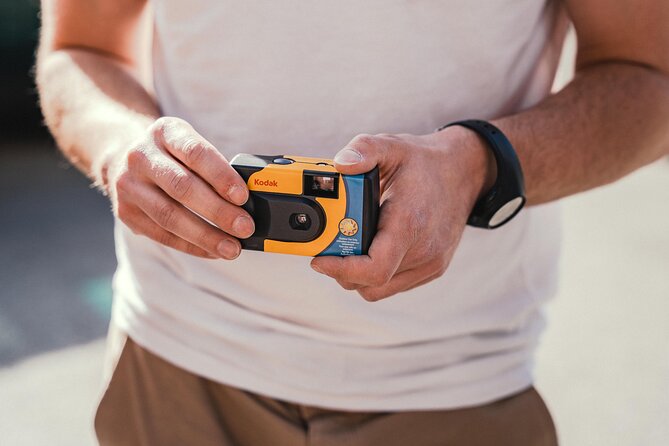
You do not need to arrive as a photography expert. The tour includes a brief explanation of how to use the analog cameras, and Emese’s role is part guide, part practical instructor. One person who had never used this kind of camera before found it easy to learn, which is useful to know if your experience is limited to a smartphone.
The photographs also give the outing a personal result. You are not simply passing a church or bridge while someone talks. You are making souvenirs along the way. The available feedback describes the printed images as one of the best parts of the experience, though the supplied details do not explain when or how the photographs are developed.
This is not a technical photography course. The stops are short, and the city itself remains the main subject. If you want detailed instruction in exposure, lenses, or composition, you may find the lesson too brief. If you want a friendly introduction to film photography while seeing Budapest, the format makes good sense.
Other Budapest days people book alongside this one:
- Budapest: City Highlights Cruise with Welcome Drink
★ 4.6 · 35,610 reviews - Budapest: Unlimited Prosecco, Beer and Aperol Spritz Cruise
★ 4.8 · 25,310 reviews - Budapest: Széchenyi Spa Day Ticket with Optional Upgrades
★ 4.3 · 23,911 reviews
Starting at St. Stephen’s Basilica
The meeting point is CBI CompareBudapest at Anker köz 2-4, in central Budapest. The tour starts at 5:00 pm, giving you an early evening setting for the first photographs.
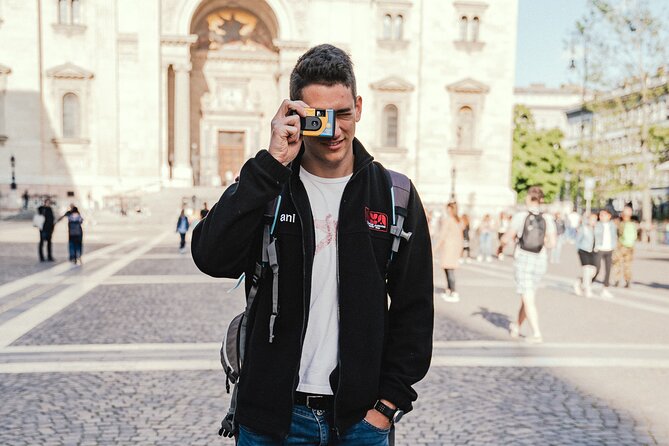
The opening stop is St. Stephen’s Basilica, one of Hungary’s most important churches. You spend about 15 minutes looking around and hearing about its history. That is enough time to get a first lesson with the camera and photograph the building’s grand exterior, though it is not a full church visit.
The basilica is a strong place to begin because it gives you a clear architectural subject. Its scale and detail reward careful framing, and the guide can provide context before you move on. I would arrive a little early so you can find the meeting point without rushing through the camera introduction.
Chain Bridge, Buda Castle, and the first river views
The next stop is the Széchenyi Chain Bridge, where you spend another 15 minutes photographing the bridge with Buda Castle behind it. This is one of the most useful stops for understanding Budapest’s layout. The Danube divides Buda and Pest, while the bridge links the two historic sides.
The view is broad and instantly recognizable, but the analog format changes how you approach it. Instead of taking ten nearly identical phone pictures, you need to choose the angle and moment that matter. The castle in the background gives the frame depth, while the bridge provides strong lines through the picture.
The tour then uses Tram 2. The supplied details identify this as part of the route, but do not give the exact ride length or explain whether a separate transit ticket is needed. You should ask Emese if you need clarity before departure. The tram is a practical part of the experience because it connects the riverfront sights without turning the whole outing into a long walk.
Parliament and Kossuth Lajos Square
At the Hungarian Parliament Building, the group spends about 15 minutes around Kossuth Lajos Square. You hear about the history of the area and photograph the surroundings of the Parliament.
This stop is less about entering the building and more about seeing it in its civic setting. The square gives you room to look at the building’s scale and position along the Danube. It also creates a change of subject after the bridge and castle view.
You should keep your expectations clear here: the experience includes a look at the surroundings, not a stated interior tour of Parliament. That distinction matters if seeing the inside of the building is a priority. For a first look at Budapest, though, the square is an important stop and fits the tour’s focus on city views rather than museum-style visits.
Same city, a completely different sort of day:
- Budapest: Nighttime or Daytime Sightseeing Cruise
★ 4.2 · 21,062 reviews - Budapest: 1-Hour Evening Sightseeing Cruise with Drink
★ 4.5 · 8,330 reviews - Budapest Danube Cruise and Dinner Options, Live Music and Dance
★ 4.5 · 7,428 reviews - Budapest: Historic Cruise with Welcome Drink
★ 4.7 · 6,512 reviews
Margaret Bridge gives the route a wider picture
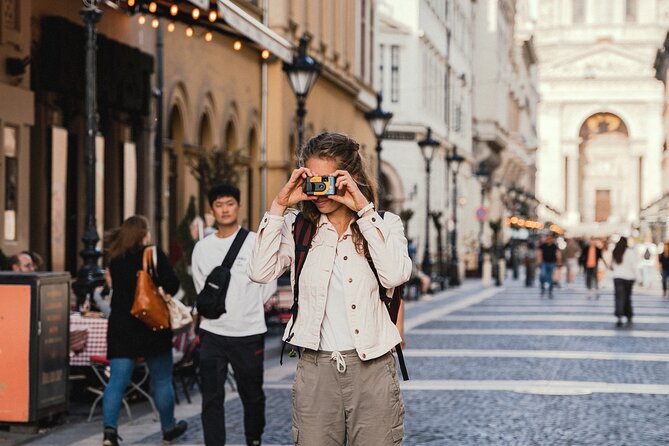
Margaret Bridge is a particularly thoughtful stop because it lets you look back at the places you have already seen and ahead toward the next part of the route. The group spends about 15 minutes here.
This is where the outing becomes more than a checklist of famous buildings. You can connect the Basilica, bridges, river, and Buda side in one broad view. The bridge also gives you a chance to compare the images you have taken so far and adjust how you use the camera.
The stop is valuable for anyone who wants to understand Budapest geographically. You are not just being carried from one landmark to another. You are seeing how the city’s major districts relate to one another across the Danube.
Matthias Church and the Castle District
The route continues into Buda, with a five-minute stop at Matthias Church. The purpose is straightforward: photograph the striking Gothic church.
Five minutes is a very short visit. You can make a quick image and hear a compact introduction, but you should not expect time for a long look or a detailed discussion of the church. This is one of the clearest tradeoffs in the schedule. The tour covers many major sights, but the time at each one is limited.
Matthias Church is paired with Fisherman’s Bastion, so the two stops work well together. The church offers a focused architectural subject, while the Bastion provides open views and a more expansive setting. The contrast helps keep the photo walk varied.
Fisherman’s Bastion is the final frame
The final stop is Fisherman’s Bastion, where you spend about 15 minutes looking around the Castle District and photographing the structure. The Bastion was inspired by early medieval architectural styles, and its towers and viewing points give the final part of the tour a distinctive character.
The tour ends here, at Fisherman’s Bastion in Budapest’s 1014 district. That is useful for planning because you do not return to the starting point. You can continue your evening in the Castle District after the tour, or arrange your own way back to central Budapest.
The final location also gives the outing a natural ending. You begin with a major church in central Pest and finish among the castle quarter’s historic buildings and elevated views. If you prefer tours that end near your hotel or at the original meeting point, this arrangement may be less convenient.
What the $142.97 price includes in practical terms
At $142.97 per person, this is not a budget sightseeing walk. The value depends on how much you care about the analog camera element, the small group, and the guided route.
You are paying for several things at once:
- A roughly three-and-a-half-hour experience
- An English-speaking guide
- A short introduction to analog cameras
- A route connecting central Pest, the Danube, and Buda
- Guided stops at six major locations
- A small group capped at 12 people
- Physical photographs as souvenirs
The price makes more sense if you would otherwise book a city tour and a separate photography activity. It is less convincing if you only want basic historical commentary or a quick list of landmarks. The tour does not include stated admission to paid attractions, and each listed stop is described as free admission, so the cost is tied mainly to the guide, the camera experience, and the route.
The supplied comments repeatedly praise Emese’s communication, patience, and friendly manner. One couple who moved slowly said the tour ran longer than planned, with Emese remaining patient. That suggests some flexibility, though you should not assume every departure will run past the stated three-and-a-half-hour estimate.
Timing, group size, and the weather question
The scheduled start is 5:00 pm, and the experience lasts about three hours and 30 minutes. Several stops last 15 minutes, while Matthias Church receives only five minutes. This is a fairly active schedule, with limited time to linger at any single sight.
The maximum group size is 12. That is small enough for direct questions and camera help, while still large enough that you will not have a fully private tour. If you want personal photography coaching at every stop, the group limit does not guarantee that level of attention.
Good weather is required. If poor weather cancels the experience, you are offered another date or a full refund. You can cancel for a full refund if you do so at least 24 hours before the start time. Cancellations or changes made less than 24 hours before the start are not refunded or accepted, so check the forecast before the deadline.
The tour is near public transportation, and Tram 2 is part of the route. Service animals are allowed, and most people can participate. The supplied information does not give a detailed mobility description, so anyone with specific access needs should contact Emese before booking.
Who will get the most from this experience
I would recommend this trip to you if you want a social, creative way to see Budapest and like the idea of leaving with physical images. It suits first-time analog camera users, couples, friends, and anyone who finds a standard lecture-style tour too passive.
It is also a good fit for an interrail itinerary or a short Budapest stay. The route covers many of the city’s major sights in one evening, and the guide’s explanations help connect the places instead of treating them as isolated photo stops.
You may want a different activity if you need a slow-paced architectural tour, a private guide, an indoor visit to Parliament or the Basilica, or a serious photography class. The schedule is broad rather than deep. You see a lot, but some stops are deliberately brief.
The tour also works best for people comfortable with a little uncertainty. Analog photography is part of the fun, but it does not offer the instant checking and unlimited retakes of a phone. If a perfect image matters more to you than the process, the format may feel restrictive.
Should you book the Analog Photo Trip?
Book it if the camera experience is the main attraction for you. Emese Tárnok’s calm instruction, the manageable group size, and the chance to collect physical photographs make this more personal than a standard Budapest highlights walk.
Think twice if $142.97 feels high for a short tour or if you want extended time inside the sights. The best reason to choose this experience is not simply that it visits famous places. It is that you get to see them with a camera in hand, move through the city by tram and on foot, and finish with something more lasting than phone pictures.
FAQ
Where does the Analog Photo Trip start?
It starts at CBI CompareBudapest, Anker köz 2-4, 1061 Hungary.
What time does the tour begin?
The scheduled start time is 5:00 pm.
Where does the tour end?
The experience ends at Fisherman’s Bastion in Budapest, 1014 Hungary.
How long does the experience last?
It lasts approximately three hours and 30 minutes.
Which language is offered?
The experience is offered in English.
How many people can join the tour?
The maximum group size is 12 people.
Which Budapest sights are included?
The route includes St. Stephen’s Basilica, the Chain Bridge, the Hungarian Parliament Building and Kossuth Lajos Square, Margaret Bridge, Matthias Church, and Fisherman’s Bastion.
Do I need previous analog photography experience?
No previous experience is stated as required. The tour includes a brief instruction on using the analog cameras.
Can I cancel for a full refund?
Yes. You can cancel at least 24 hours before the scheduled start for a full refund. If poor weather causes the tour to be canceled, you are offered another date or a full refund.
Just added around Budapest
- Budapest: Danube River Views Bike Ride★ 4.8 · 23 reviews
- Budapest: City Bike Tour with Coffee Stop★ 5.0 · 37 reviews
- Budapest: Private Walking Tour with a Local Guide★ 3.6 · 6 reviews
- Budapest: Vacation Photographer to collect great memories★ 5.0 · 49 reviews
- Walk to recent and aged spiritual sanctuaries near Budapest★ 5.0 · 5 reviews
- From Budapest: Guided Tour of Eger with Wine Tasting★ 4.5 · 6 reviews
- Audio visual multi-sensory chefs journey dinner experience★ 5.0 · 3 reviews
- Budapest: 3-Hour Trabant Sightseeing Tour★ 4.7 · 28 reviews